
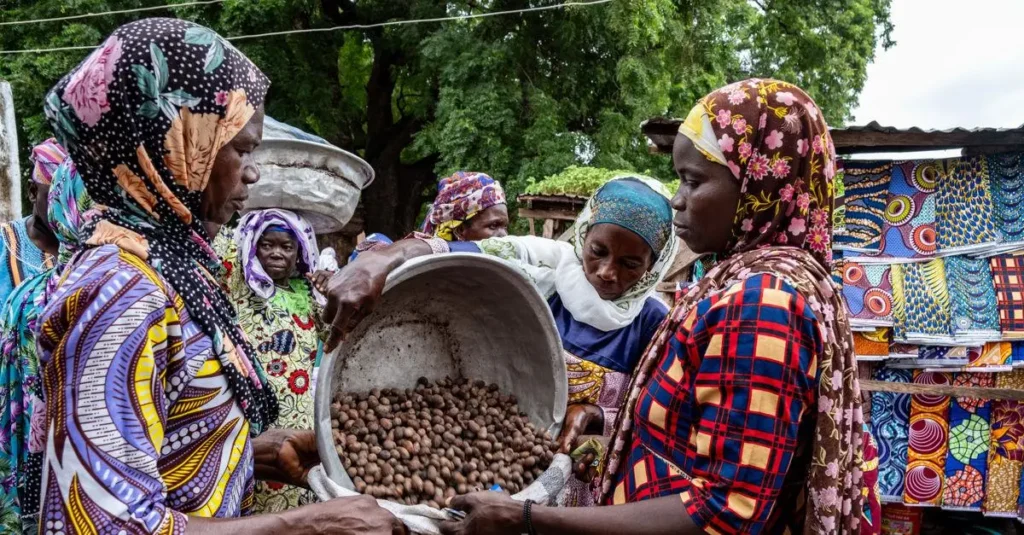
How Ghana’s shea industry is evolving through industrial processing, changing market requirements, responsible sourcing, and the growing opportunity to create more value within Africa.
Introduction: A Commodity with Far Greater Potential
Across the savannah landscapes of northern Ghana, the shea tree has supported livelihoods, local trade and communities for generations. What begins as a fruit gathered from naturally growing trees eventually becomes an important ingredient in products consumed around the world.
From cosmetics and personal care products to food manufacturing and industrial fats, shea has developed into a commercially significant agricultural commodity.
Yet the economic opportunity surrounding shea extends beyond the raw kernels themselves.
The future of the industry increasingly depends on how effectively producing countries can organise supply chains, improve product quality, expand processing capacity and retain more value within their economies.
Ghana stands at an important point in that transition.
According to the United Nations Development Programme (UNDP), Ghana produces an estimated 130,000 to 150,000 metric tonnes of shea nuts annually.
The industry is also an important source of income for women in northern Ghana and a contributor to the country’s agricultural economy.
In 2026, renewed policy attention, investment initiatives and growing interest in value addition are creating opportunities for processors, investors, commodity traders and international buyers.
The central question is no longer simply how much shea Ghana can supply.
It is how much economic value Ghana and the wider West African region can create from that supply.
1. Understanding the Economic Importance of Shea
The shea tree (Vitellaria paradoxa) grows naturally across the African shea belt, extending through several countries in West, Central and East Africa.
Unlike many commercially cultivated crops, much of the shea supply originates from naturally occurring trees on agricultural parklands.
The harvested fruit contains a nut, which is processed to recover the kernel used in producing shea butter and other shea-derived ingredients.
The Global Shea Alliance estimates that approximately 16 million women across Africa participate in collecting shea fruits and kernels. This illustrates the sector’s significant contribution to rural livelihoods.
The shea value chain involves multiple participants:
- Collectors and producers, who gather and prepare shea nuts.
- Aggregators and commodity traders, who connect producing communities with commercial buyers.
- Processors, who transform kernels into butter, stearin, olein and other ingredients.
- Manufacturers, who incorporate shea products into food, cosmetic and industrial applications.
- Exporters and international buyers, who connect African production with overseas markets.
Each stage contributes to the final commercial value of shea.
For Ghana, the opportunity is to strengthen these connections while supporting more efficient sourcing, processing, employment and commercial partnerships.
2. Beyond Cosmetics: The Expanding Industrial Uses of Shea
Shea is commonly associated with moisturisers, soaps and body-care products. However, its commercial applications are considerably broader.
Food and confectionery manufacturing
Shea-derived fats, particularly shea stearin, are used in specialised vegetable-fat formulations and can contribute to cocoa butter equivalent products where permitted by applicable food regulations.
This makes shea relevant to parts of the confectionery and food ingredients industries.
Cosmetics and personal care
Shea butter is widely used in skincare and haircare formulations because of its fatty-acid composition, texture and emollient properties.
Its applications range from mass-market personal care products to premium cosmetic formulations.
Pharmaceutical and wellness applications
Shea-derived ingredients are also used in certain pharmaceutical and topical formulations, where ingredient quality and suitability for the intended application are important.
These diverse uses demonstrate why shea should be understood as an industrial agricultural raw material, rather than only a traditional beauty ingredient.
For processors and buyers, the important considerations include consistent raw-material supply, suitable product specifications, processing performance and dependable commercial relationships.
3. Ghana’s Shea Industry in 2026: Three Important Developments
Several developments in 2026 suggest that Ghana is placing greater emphasis on the long-term competitiveness of its shea sector.
A. Stronger coordination across the industry
In June 2026, the National Shea Commodity Platform was launched through collaboration involving the Tree Crops Development Authority, UNDP, the Forestry Commission and the Global Shea Alliance.
The initiative seeks to improve coordination, information sharing, policy engagement, market access and investment alignment across the sector.
According to UNDP Ghana, fragmented industry coordination and limited market access have been persistent challenges.
A more coordinated value chain could improve how producers, aggregators, processors and buyers interact.
B. Greater emphasis on processing and industrialisation
In September 2026, Ghana hosted the World Shea Expo in Tamale, bringing together industry stakeholders, processors, investors, international buyers and policymakers.
The event highlighted the importance of value addition, processing investment, product innovation and stronger participation by women and young people.
The policy direction is significant.
Ghana’s ambition is not merely to increase the quantity of shea traded but to expand the industrial activities that transform raw agricultural materials into commercially valuable products.
The Ghana News Agency’s September 2026 report provides further details of the discussions and investment priorities.
C. A more structured regulatory environment
The Tree Crops Development Authority announced a minimum producer price of GH₵9.01 per kilogram for raw shea kernels, effective June 1, 2026.
The announcement referenced quality parameters covering moisture content, free fatty acids and impurities.
TCDA also reinforced export-permit requirements for regulated tree crops, including shea.
These measures underline the increasing importance of regulatory compliance, transparent transactions and quality assessment in agricultural commodity trade.
For buyers and suppliers alike, staying informed about such requirements is essential.
Source: TCDA — 2026 Shea Producer Price Announcement. The minimum producer price is not a universal wholesale or export quotation, and individual buyer specifications may differ from the parameters used in the announcement.
4. The Opportunity: Moving from Raw Shea Nuts to Value-Added Products
One of the most important questions facing African agriculture is how producing economies can retain more of the value generated from their natural resources.
Shea illustrates this challenge.
Raw shea kernels have commercial value, but additional activities—such as extraction, refining, fractionation, quality testing and packaging—create further opportunities for industrial activity and revenue generation.
The value chain can be represented as follows:
Shea fruit collection → Kernel preparation → Aggregation → Butter extraction → Refining and fractionation → Industrial ingredients → Finished consumer products
Each stage creates different requirements for technology, labour, infrastructure, finance and market access.
Expanding local processing can potentially support:
Greater industrial capacity. Processing facilities create demand for machinery, engineering, energy, technical expertise and supporting services.
Employment and skills development. Processing creates opportunities for technicians, operators, quality-control professionals, logistics providers and commercial teams.
Product diversification. Producers and processors can participate in a wider range of product categories rather than relying exclusively on raw commodity sales.
Stronger export opportunities. Refined and semi-processed ingredients can serve different types of international buyers.
Additional value retained in producing economies. When more industrial activities occur locally, a greater proportion of associated wages, services and commercial activity can remain in the region.
Importantly, West Africa is not starting from zero.
The Global Shea Alliance reports that more than half of shea exports are now processed within West Africa, reflecting substantial progress in regional processing capabilities.
The next challenge is to build on that foundation through competitive investment, consistent input supply and stronger market integration.
5. Five Market Opportunities for Ghana’s Shea Industry
Opportunity 1: Reliable supply for industrial processors
Industrial processing depends on predictable access to raw materials.
For processors, supply interruptions can affect production schedules, operating costs and customer commitments.
This creates demand for sourcing organisations with knowledge of producing regions, established buying relationships, aggregation capabilities and an understanding of processor requirements.
The commercial opportunity is not simply to identify available quantities of shea nuts.
It is to develop sourcing arrangements that align quantity, quality, timing and delivery with the buyer’s operational needs.
Opportunity 2: Investment in processing infrastructure
As Ghana seeks to strengthen local value addition, opportunities are emerging across butter extraction, refining, fractionation, quality testing, packaging and industrial logistics.
The sector is already attracting attention from established industry participants.
In February 2026, AAK Ghana and the Ministry of Food and Agriculture signed a memorandum of understanding focused on local processing, sustainable sourcing and competitiveness.
The Ghana News Agency reported plans for investment in processing, skills development and supply-chain improvements.
However, successful processing investment requires more than plant construction.
Commercial viability depends on reliable feedstock, competitive energy and operating costs, equipment performance, working capital and access to markets for finished products.
Opportunity 3: Quality assurance and product consistency
Quality is a fundamental factor in shea trade.
The condition of raw kernels can influence processing efficiency, extraction outcomes, product quality and commercial acceptance.
Important considerations may include:
- Moisture content and proper drying.
- Free fatty acid levels.
- Foreign matter and impurities.
- Storage and handling conditions.
- Lot identification, sampling and testing.
For professional buyers, clear specifications and inspection procedures help reduce uncertainty and disputes.
For sourcing companies, the ability to communicate accurately about quality requirements can be an important competitive advantage.
Opportunity 4: Responsible sourcing and stronger producer relationships
The economic sustainability of shea depends partly on the communities that collect and prepare the raw material.
Women play a particularly important role in this value chain.
Improving producer access to markets, information, appropriate equipment and commercial opportunities can support a more inclusive industry.
At the same time, shea trees contribute to the ecological resilience of agricultural landscapes.
Deforestation, land-use change, climate variability and degradation of shea parklands present long-term risks to supply.
Responsible sourcing therefore involves both commercial and environmental considerations.
For international buyers, understanding where raw materials originate and how sourcing relationships are managed can support more informed procurement decisions.
Opportunity 5: Stronger connections between West African supply and international markets
West Africa’s shea-producing countries have significant commercial relationships with processors and buyers around the world.
Nevertheless, differences in infrastructure, regulations, seasonal availability and transportation costs create operational complexities.
Companies with regional market knowledge can help connect agricultural production with buyer requirements.
The opportunity lies in improving coordination across the supply chain—from the point of sourcing to the delivery of suitable materials to processors.
As the shea industry becomes more industrialised, dependable origin partnerships will remain an important part of its competitiveness.
6. What Shea Buyers Should Prioritise in 2026 and Beyond
For processors and procurement teams, purchasing shea nuts is not solely a matter of comparing prices.
A dependable procurement strategy should address several questions.
Can the supplier access the required quantities?
Understanding the supplier’s sourcing footprint and the seasonality of available materials helps buyers plan procurement more effectively.
Are the product specifications clearly defined?
Buyers and suppliers should agree on quality parameters, acceptable tolerances, sampling methods and inspection responsibilities.
How will the product be handled and delivered?
Storage, packaging, transport arrangements and delivery scheduling can influence both quality and operational efficiency.
Are the trading arrangements compliant?
Commodity traders and exporters must understand the applicable laws, permits and documentation requirements in their countries of operation.
Can the relationship support long-term requirements?
Stable commercial relationships can improve communication, procurement planning and responsiveness when market conditions change.
For agricultural commodities, the lowest quoted price is not always the lowest total procurement cost.
Unreliable deliveries, inconsistent quality and poorly defined contractual terms can introduce additional costs and operational risks.
Successful sourcing therefore requires a balance between commercial competitiveness and supply-chain reliability.
7. The Challenges Ghana Must Address
Despite the opportunities, the growth of Ghana’s shea industry is not guaranteed.
Several structural challenges continue to influence competitiveness.
Supply-chain fragmentation: Smaller producers and collectors may face difficulties accessing structured markets, finance and reliable market information.
Infrastructure limitations: Storage, transportation, energy and processing infrastructure affect operational costs and the industry’s capacity to scale.
Seasonal supply patterns: Shea harvesting follows seasonal cycles, making procurement planning and inventory management important.
Climate and environmental risks: Changes in rainfall, land use and the condition of shea parklands can threaten long-term production.
Access to investment: Industrial processing requires substantial capital expenditure and ongoing working capital.
International competitiveness: Ghanaian processors must compete on quality, production costs, reliability and customer requirements, not simply raw-material availability.
Addressing these constraints requires cooperation among governments, industry associations, private businesses, development partners and producing communities.
Value addition is an important objective, but it must be supported by commercially sustainable operations.
8. Parin Africa’s Role in Strengthening the Shea Value Chain
For Parin Africa Limited, the evolution of Ghana’s shea industry is closely connected to its existing business activities and long-term development plans.
Established in 2019 and headquartered in Accra, Parin Africa operates an agricultural commodities sourcing network across Ghana, Burkina Faso, Togo and Côte d’Ivoire.
Shea nuts are one of the company’s core commodities.
According to Parin Africa’s 2026 company profile, the business trades approximately 50,000 metric tonnes of shea nuts annually across its regional sourcing network, supplying processors and offtakers in Ghana.
This regional trading volume should not be confused with Ghana’s national production statistics.
The company’s role in the shea value chain currently centres on sourcing and supplying raw shea kernels to processors.
Looking ahead, Parin Africa plans to expand into value-added shea production through a proposed three-in-one shea butter processing and refinery plant in Ghana’s Dawa Industrial Free Zone.
As outlined in its 2026 company profile, the proposed project has the following targets:
- Annual shea nut input capacity of 50,000 metric tonnes.
- Approximately 18,000 metric tonnes of annual shea butter output at planned operating capacity.
- An estimated 100 local jobs.
- A scheduled construction commencement in March 2027.
The facility remains a planned development, and these figures represent project targets rather than existing production.
The proposed investment reflects Parin Africa’s longer-term ambition to participate in a greater share of the agricultural value chain—from sourcing raw commodities to adding value through local processing.
This direction is consistent with the broader movement towards industrialisation and value addition in Ghana’s shea sector.
At Parin Africa, we believe that building stronger connections between origin markets, processors and buyers is fundamental to the long-term development of African agricultural trade.
9. Looking Ahead: What Could Shape the Shea Industry in 2027 and Beyond?
Ghana’s next phase of shea development will likely be influenced by how successfully the sector combines several priorities.
First, the availability of reliable raw materials must keep pace with investments in local processing.
Second, processors must be able to manufacture products that meet the technical and commercial requirements of their target markets.
Third, better coordination between producers, traders, processors and regulators can help improve market efficiency.
Fourth, the preservation of shea parklands and the economic participation of producing communities will remain important to long-term sustainability.
Finally, Ghana’s success in value addition will depend on whether businesses can build internationally competitive processing operations that sustain demand, employment and commercial growth.
Expanding processing capacity is an opportunity—not an automatic guarantee of higher margins or stronger exports.
The most durable gains will come from combining industrial investment with consistent product quality, commercial discipline and dependable supply relationships.
Conclusion: Building Greater Value from Africa’s Agricultural Resources
The shea industry illustrates both the strength and the opportunity of African agriculture.
Its importance extends far beyond cosmetics.
It connects rural livelihoods, agricultural production, industrial processing, regional commerce and international manufacturing.
In 2026, Ghana’s renewed focus on investment, market coordination and value addition signals an important ambition for the sector.
But real progress will depend on execution.
Reliable sourcing, competitive processing, quality assurance, responsible supply practices and lasting partnerships must work together.
For Parin Africa Limited, these priorities are central to its vision of connecting West African agricultural commodities with dependable markets while supporting greater value creation at origin.
The future of African agriculture is not only about what the continent produces. It is also about the value it creates from what it produces.
Work With Parin Africa
Parin Africa Limited sources and supplies shea nuts to processors and offtakers in Ghana through its West African sourcing network.
For sourcing enquiries, commodity supply discussions or potential business partnerships, contact our team.
Email: info@parinafrica.com
Website: www.parinafrica.com
Parin Africa Limited — From West Africa’s Farm Gate to Global Markets.
Research Sources
- UNDP Ghana — New Platform Launched to Unlock Opportunities for More Women in Ghana’s Shea Sector, June 2026
- Global Shea Alliance — Industry Overview
- Tree Crops Development Authority — Minimum Producer Price for Raw Shea Nuts, 2026
- Ghana News Agency — World Shea Expo 2026, September 2026
- Ghana News Agency — AAK and Ministry of Food and Agriculture Partnership, February 2026
- Parin Africa Limited — Company Profile 2026 (company-provided business information).